
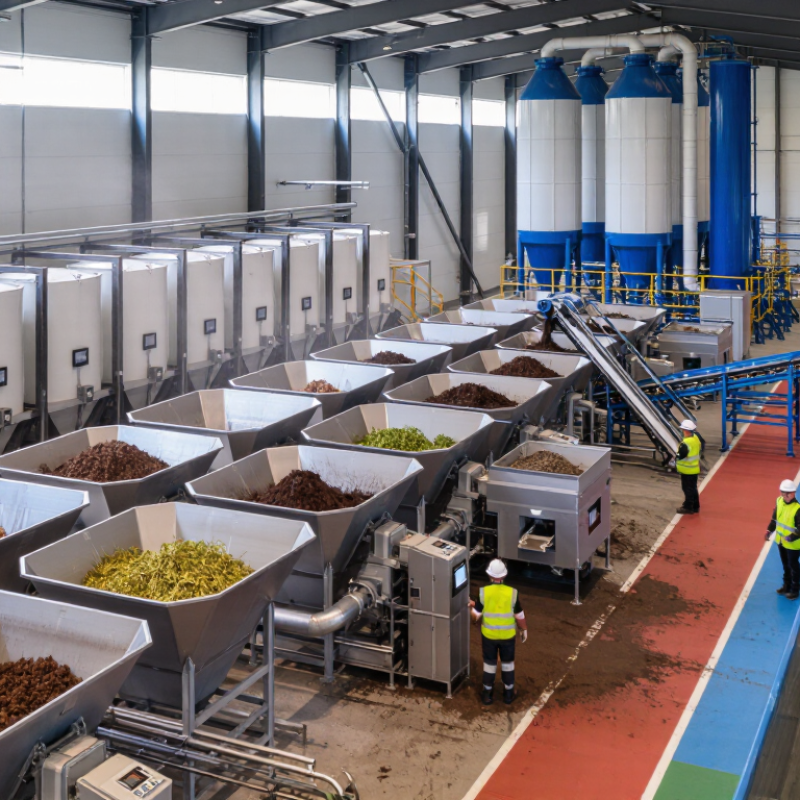
7 Tips for Choosing an Organic Fertilizer Processing Plant

Choosing an Organic Fertilizer Processing Plant is a practical decision with long-term consequences. The right facility must protect product quality, worker safety, operating costs, and environmental performance. A polished brochure is not enough.

The FiBL and IFOAM–Organics International report recorded 96.4 million hectares of organic farmland worldwide in 2022. It also reported global organic retail sales of approximately €134.8 billion. These figures show expanding demand for reliable organic inputs. However, market growth does not guarantee that every processing line can deliver consistent fertilizer. Equipment capacity, feedstock control, moisture management, and certification support require careful examination.

Small details matter. Ask how the plant handles manure, crop residues, or food-processing by-products. Check whether fermentation temperatures are recorded automatically. Inspect the compost turning system, odor-control equipment, screening unit, and final-bagging area. The FAO emphasizes nutrient efficiency and sustainable soil management in its soil-related guidance. Therefore, a suitable facility should provide laboratory testing for nitrogen, phosphorus, potassium, moisture, pathogens, and heavy metals, where applicable. Request recent test records, not only promises.

No checklist is flawless. A low purchase price can become expensive through downtime, unstable output, or difficult maintenance. Supplier experience matters, but local service matters more than impressive photographs. Compare energy consumption, spare-part availability, installation support, operator training, and realistic production capacity. These seven tips help buyers evaluate an Organic Fertilizer Processing Plant with evidence, not assumptions. A thoughtful choice may take longer. It usually prevents bigger problems later.

7 Tips for Choosing an Organic Fertilizer Processing Plant

Define Your Organic Fertilizer Production Requirements

7 Tips for Choosing an Organic Fertilizer Processing Plant

Define Your Organic Fertilizer Production Requirements

Start with the material, not the machinery. List every feedstock, including manure, crop residues, food waste, and green waste.

The UNEP Food Waste Index Report 2024 estimates that 1.05 billion tonnes of food were wasted in 2022. However, not all waste is suitable for fertilizer production. Salt, plastic, glass, and chemical residues can damage product quality.

Measure your daily input realistically. A plant designed for 20 tonnes per day may fail during seasonal peaks. Record moisture, carbon-to-nitrogen ratio, particle size, and contamination levels. These details determine whether you need composting, fermentation, crushing, screening, drying, or granulation equipment. Small differences matter. A wet feedstock may require longer treatment and higher energy use.

Define the final product before comparing plants. Set targets for moisture, organic matter, nutrient content, particle size, odor, and storage life.

The FAO and Intergovernmental Technical Panel on Soils reported that about 33% of global soils are moderately or highly degraded. This supports soil-improvement demand, but it does not justify vague specifications.

My first planning mistake would be choosing capacity before confirming the product standard. Build a testing plan instead. Require sampling points, laboratory access, temperature records, and batch traceability.

Also check local fertilizer rules, wastewater controls, and permitted feedstocks. A cheaper line can become expensive when it cannot handle your actual material.

Assess Plant Capacity, Equipment, and Processing Methods

Choosing an Organic Fertilizer Processing Plant

Assess Plant Capacity, Equipment, and Processing Methods

A plant’s advertised capacity can mislead. Ask whether the figure reflects wet feedstock, dried product, or peak output. Compare it with your daily supply, seasonal surges, and available storage. A practical design should leave operating room, not run continuously at its limit. For example, a line rated at 10 tons per hour may process less when material is sticky or uneven.

Inspect the equipment as a connected system. A crusher must match the incoming particle size. Mixers should produce a consistent blend without dead corners. Granulators need stable moisture control. Dryers require measured heat, airflow, and safe dust management. Screens and conveyors affect final quality more than many buyers expect. Request maintenance records, test results, spare-parts plans, and a live trial using your own feedstock. Good questions reveal more than polished brochures.

Processing methods should suit the material and product goal. Aerobic composting needs controlled oxygen, moisture, temperature, and curing time. Fermentation may reduce odor, but it does not replace maturity testing. Granulation improves handling, while excessive drying can waste energy and reduce biological value. I have seen projects prioritize a fast line and underestimate curing space. That mistake is expensive. Leave room for sampling, cleaning, repairs, and process changes. A simple, documented workflow is often more dependable than a highly automated system nobody can troubleshoot.

Verify Raw Material Handling and Product Quality Systems

7 Tips for Choosing an Organic Fertilizer Processing Plant

Verify how the plant receives, identifies, and stores every raw material. The World Bank’s What a Waste 2.0 reports that organic materials represent about 44% of global municipal solid waste. That volume creates opportunity, but also contamination risk. Request written acceptance criteria for moisture, plastics, glass, stones, and chemical residues. Inspect unloading bays for covered floors, drainage control, and separate storage zones. Mixed piles are a warning sign.

Traceability must continue through shredding, composting, curing, screening, and packing. Ask for batch codes, temperature logs, turning records, and corrective-action reports. UNEP’s Food Waste Index Report 2024 estimated 1.05 billion tonnes of food waste were generated in 2022. A serious processor should explain how such variable feedstocks become consistent products. Look for routine tests covering moisture, organic matter, nutrient content, pathogens, and heavy metals. Independent laboratory results matter more than attractive certificates.

Product claims need evidence. Check sampling frequency and laboratory accreditation. Ask whether results represent the whole batch, not only a convenient sample. I would examine three recent production lots, not one perfect report. Sometimes records are incomplete. That deserves a direct explanation. A plant that admits process weaknesses may be more reliable than one promising flawless uniformity. Confirm storage controls too, because damp finished fertilizer can cake, lose quality, or develop odors before delivery.

Review Environmental Controls, Certifications, and Safety Standards

7 Tips for Choosing an Organic Fertilizer Processing Plant

A reliable plant should control odors, dust, wastewater, and stormwater before problems appear. Inspect enclosed receiving areas, covered storage, and visible drainage channels. An effective odor-control system may include biofilters and logged maintenance. Ask for recent environmental inspection records, not only framed certificates. Permits vary by location. Their scope and expiration dates should match the actual operation.

Certification documents deserve careful review. Confirm the issuing body, audit date, covered processes, and renewal status. A certificate alone is not proof of good daily practice. Request evidence of soil, water, and product testing. Check how the plant prevents plastic, metal, chemical residues, and pathogens from entering finished fertilizer. Clear batch records should connect incoming materials with test results and shipment details. Traceability matters when something goes wrong.

Safety standards should be visible on the production floor. Look for guarded machinery, marked walkways, emergency stops, ventilation, and suitable protective equipment. Workers should receive documented training for dust exposure, confined spaces, heat, and equipment cleaning. Ask whether emergency drills happen regularly. Sometimes, small details reveal more than polished paperwork. A missing warning label or blocked exit deserves attention. I would also ask what the plant changed after its last incident or audit. Honest answers may be imperfect, but they show practical learning.

Compare Costs, Technical Support, and Future Expansion Options

7 Tips for Choosing an Organic Fertilizer Processing Plant

Compare the complete cost, not only the equipment quotation. Ask for energy use per tonne, labor needs, spare-part prices, installation charges, and expected maintenance hours. Measure twice. A low-cost dryer may consume more fuel and reduce margins during wet seasons. Use a five-year ownership model. The World Bank Commodity Markets Outlook shows that fertilizer prices can change sharply, so test your budget under higher raw-material and energy prices. Request performance data from similar plants, including moisture levels, output rates, and downtime.

Technical support deserves equal attention. Check whether engineers can provide process design, commissioning, operator training, and remote troubleshooting. Ask for written response times. Also inspect the laboratory plan. Reliable testing should cover moisture, organic matter, pH, particle size, and maturity. FAO fertilizer statistics distinguish nutrient content from finished-product weight, which prevents misleading capacity comparisons. A plant producing 10 tonnes of wet material is not producing 10 tonnes of saleable fertilizer. Small detail. Big cost.

Plan expansion before construction begins. IFA’s Fertilizer Outlook 2024–2028 expects global fertilizer demand to approach 205 million tonnes of nutrients by 2028, supporting careful capacity planning. Leave space for an additional mixer, curing area, screening line, and storage silos. UNEP’s Global Resources Outlook 2024 warns that global material extraction could rise 60% by 2060, making efficient material use increasingly important. Avoid oversized equipment today. I would rather add modular capacity than pay for idle machinery, though every forecast can fail. Check local feedstock supply, utility limits, road access, and future permitting requirements before signing.

7 Tips for Choosing an Organic Fertilizer Processing Plant

Compare costs, technical support, and future expansion options using a practical planning-weight framework. The percentages show how much each factor may contribute to a balanced purchasing decision.

Cost and process suitability receive the highest weighting because they directly affect project feasibility. Technical support, scalability, energy efficiency, quality control, and maintenance should also be verified through technical proposals and site-specific calculations.

Select Electrical Logo
Since 1988

Select Electrical Ltd. © Copyright 1988-2025