China Best Motor Starter Types and Their Applications?
The motor starter industry in China has witnessed significant growth, driven by increasing industrial automation. According to a recent market report from ResearchAndMarkets, the motor starter market is expected to grow at a CAGR of 7% through 2028. This growth highlights the rising demand for efficient motor control solutions across various sectors, including manufacturing, construction, and agriculture.
Expert Insight: Dr. Li Wei, a leading authority in motor control technology, states, "The right motor starter can significantly enhance operational efficiency." This statement underscores the importance of selecting the appropriate motor starter type for different applications. For instance, Direct-On-Line (DOL) starters are commonly used in simple applications, while Star-Delta starters are preferable for larger motors requiring reduced starting current.
Despite advancements, challenges persist. Some manufacturers struggle with integrating smart technologies into their motor starters. Additionally, not all companies fully understand the implications of choosing one type over another. This reflection is essential for optimizing performance and ensuring reliability in motor operations. Understanding these nuances is vital for industries aiming to maximize efficiency and minimize operational costs in today's competitive landscape.
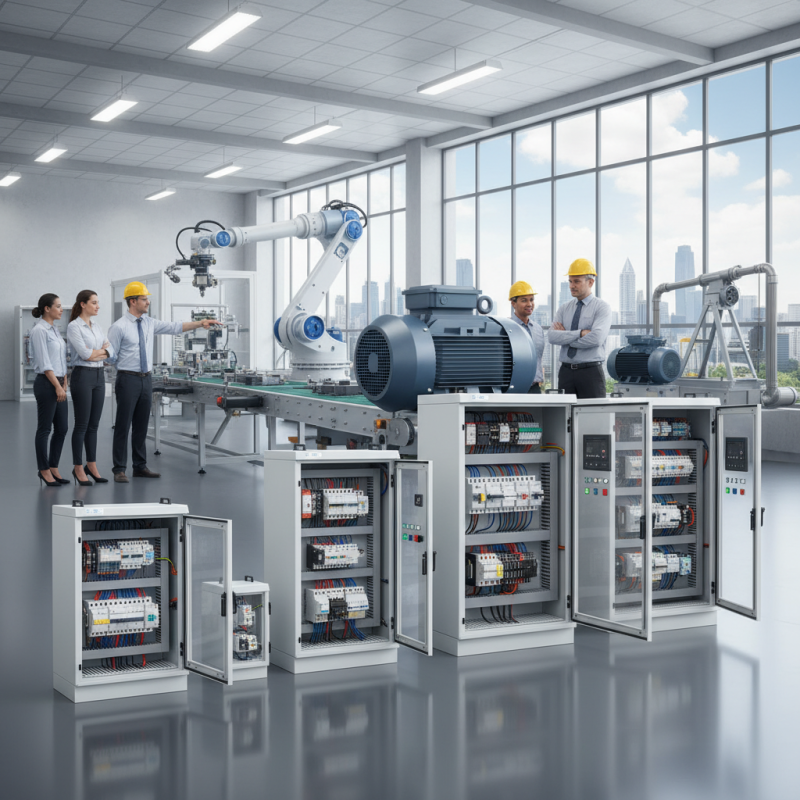
Types of Motor Starters Commonly Used in China’s Industry
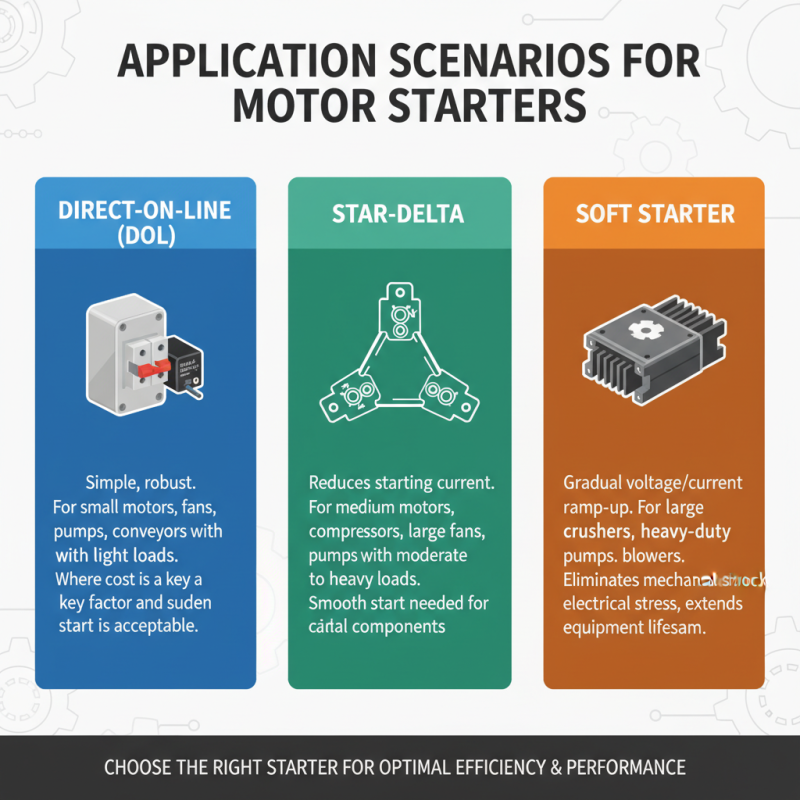
In China's industrial landscape, motor starters are crucial for efficient operation. Common types include direct-on-line (DOL), star-delta, and soft starters. Each type caters to specific applications, optimizing energy use and equipment longevity. According to recent industry reports, nearly 45% of all motor starters in use are DOL types, favored for their simplicity and reliability.
Star-delta starters are popular in larger motors, providing a reduced start-up current. This approach decreases electrical stress on the system. Industry data indicates that approximately 30% of manufacturers utilize star-delta starters for three-phase motors. Soft starters are increasingly chosen for applications requiring smooth acceleration, reducing mechanical wear. These starters are projected to grow in market share due to their ability to enhance operational efficiency.
Despite advancements, challenges remain. Many operators still rely on older technologies, which may not meet modern energy efficiency standards. Transitioning to more advanced systems can be daunting for these manufacturers. Additionally, the complexity of installation and maintenance might deter some users. The industry must address these gaps to ensure broader adoption of innovative starter solutions.
China Best Motor Starter Types and Their Applications
| Motor Starter Type |
Application |
Advantages |
Disadvantages |
| Direct-on-Line (DOL) |
Small motors, fans, and pumps |
Simple, low cost |
High starting current, potential motor damage |
| Star-Delta Starter |
Large motors in industrial applications |
Reduced starting current, less mechanical stress |
Requires additional wiring, more complex |
| Soft Starter |
Various applications including conveyors and compressors |
Smooth acceleration, reduced inrush current |
Higher initial cost, requires careful setup |
| Variable Frequency Drive (VFD) |
Pumps, fans, and other variable torque loads |
Energy savings, extended motor life |
Complexity, higher cost |
| Relay Starter |
General industrial motor loads |
Reliability, cost-effective for smaller motors |
Limited features, manual operation |
Key Features and Benefits of Various Motor Starter Types
Motor starters play a crucial role in the operation of electric motors. They provide a means to safely
start, stop, and protect motors from overloads and faults. One common type is the direct-on-line (DOL) starter.
This starter connects the motor directly to the power supply. It is simple, straightforward, and ideal for small motors. However, it can cause high starting currents, which may
not be suitable for larger motors.
Another type, the star-delta starter, reduces the starting current significantly. It first starts the motor in
star configuration. This method limits the voltage and current. After reaching a certain speed, it switches to delta configuration. This starter is widely used for larger
motors. It balances efficiency and cost, yet it requires additional components and careful control logic.
Soft starters offer a modern solution for controlling motor start-up. They gradually ramp up the voltage, protecting both
the motor and the electrical supply. While they may be more expensive, their benefits outweigh the costs, especially in demanding applications. On the flip side, they introduce
complexity in programming and setup.
Choosing the right motor starter depends on the specific application and environment. Understanding these aspects is
vital for optimal performance.
Application Scenarios for Different Types of Motor Starters
Motor starters are essential components in various industrial applications. They initiate the operation of electric motors. Each starter type serves specific functions, impacting efficiency and performance.
In applications such as compressors, direct-on-line (DOL) starters are widely used. This starter type connects the motor directly to the power supply. It is simple and cost-effective, making it suitable for small motors. However, it can cause high inrush currents. This may lead to mechanical stress and potential damage. Conversely, star-delta starters are ideal for larger motors. They reduce starting current by first connecting motors in a star configuration before switching to delta. This approach minimizes electrical and mechanical strain. Data suggests that star-delta starters can reduce starting current to about 30% of the locked rotor current.
Soft starters find their niche in applications requiring smooth acceleration. They limit inrush currents and allow gradual speed increase. This is beneficial for applications like conveyor systems or mixers. Studies show that using soft starters can extend the lifespan of motors significantly. However, they may not provide sufficient torque for heavy loads, raising reliability concerns. Each motor starter type has its pros and cons, emphasizing the need for careful selection based on operational requirements.
Market Trends and Future Predictions for Motor Starter Technology
The motor starter technology landscape is evolving rapidly in China. Recent trends indicate a
shift towards more efficient designs. These designs not only improve
energy consumption but also enhance the longevity of equipment. There's a growing demand for motor starters
that integrate smart technology. Smart starters
can provide real-time monitoring and predictive maintenance alerts. This development offers substantial
benefits to manufacturers and operators alike.
In terms of market predictions, the emphasis on sustainability is likely
to shape future designs. More projects are focusing on reducing carbon footprints. This will lead to innovations
in materials and energy sources for motor starters. Companies may explore hybrid solutions that combine traditional
and renewable energy. Additionally, regulations will likely tighten, pushing for higher efficiency standards.
While the future looks promising, challenges remain. Companies must invest in
R&D and training to adapt to these changes effectively.
Understanding the importance of motor starter technology is crucial for future planning. Businesses need to
stay updated on emerging trends. This requires ongoing education and a willingness to adapt. Success
depends on balancing innovation with reliability in products.
As the industry continues to evolve, clear communication and collaboration will be essential for growth.
Relevant Industry Standards and Regulations Affecting Motor Starters
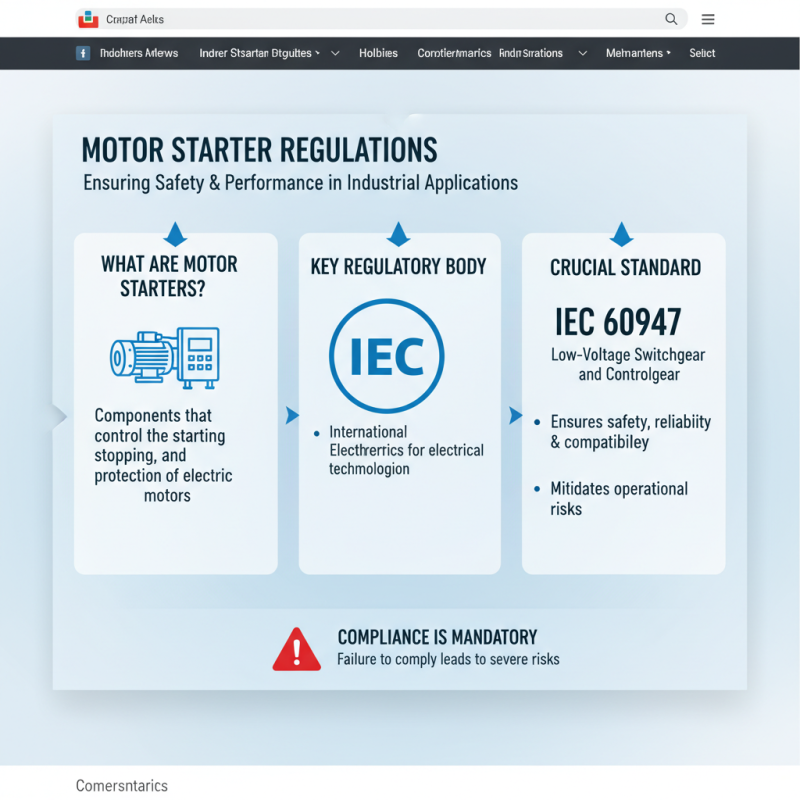
Motor starters are essential components in industrial applications, facilitating the smooth operation of electric motors. However, their design and operation must comply with strict industry standards and regulations. The International Electrotechnical Commission (IEC) sets crucial guidelines, including IEC 60947 for low-voltage switchgear and controlgear. This standard ensures safety and performance in various environments. Failure to adhere to these guidelines can result in severe operational risks.
Furthermore, the National Electrical Manufacturers Association (NEMA) provides specifications focusing on efficiency and reliability. NEMA standards define motor starter capabilities that ensure effective overload protection. Data from recent industry reports show that nearly 30% of motor faults arise from inadequate protection. This highlights the need for adherence to these vital standards, which minimizes the risk of system failures.
In the context of evolving technology, regulations also adapt. The emergence of smart motor starters introduces new compliance challenges. With features like remote monitoring, these starters must meet both safety and cybersecurity protocols. Companies often struggle to keep up with rapidly changing standards. This gap can lead to costly compliance issues if not addressed. Thus, staying informed about relevant regulations remains critical for manufacturers to ensure their motor starters are safe and reliable.