
In the rapidly evolving world of automation, choosing the right motor and control solutions can significantly impact efficiency. Experts like Dr. Emily Zhang, a leading authority in motor technology, emphasize the importance of tailored solutions. She states, “Selecting the right motor is critical; it can enhance performance and save costs.”
Motor and control solutions encompass a wide range of technologies. From DC motors to advanced servo control systems, understanding the options available is key. Each solution comes with distinct advantages and drawbacks. Using the wrong solution can lead to performance issues or increased energy costs.
Every application is unique, requiring a comprehensive evaluation of requirements. Reflections on past choices can reveal insights for future projects. Industry experts suggest that close analysis of performance needs can guide engineers to better decisions. Embracing this introspection can yield both immediate and long-term benefits in motor and control solutions.

Motor and control solutions are crucial in various industries. Proper selection can boost efficiency and reduce costs. According to a recent report by the International Energy Agency, motor systems account for about 45% of global electricity consumption in industrial applications. This highlights the need for effective control solutions that can optimize energy use.
Selecting the right motor and control system is not just about specifications. It's about compatibility and operational efficiency. A poorly matched system can lead to increased energy waste. A study by the U.S. Department of Energy indicated that optimizing motor systems can lead to savings of up to 30%. This represents a significant impact on operating costs and sustainability goals.
Understanding the importance of these solutions also encompasses recognizing areas for improvement. Manufacturers need to evaluate current setups. Routine audits can determine if systems meet the demands of modern operations. As technologies evolve, many companies find their existing motor setups inadequate, requiring timely upgrades. The cost of inaction can be steep, leading to lost productivity and higher energy bills.
This bar chart illustrates key performance metrics for selecting optimal motor and control solutions, emphasizing the significance of efficiency, torque, speed, durability, and response time in decision-making.
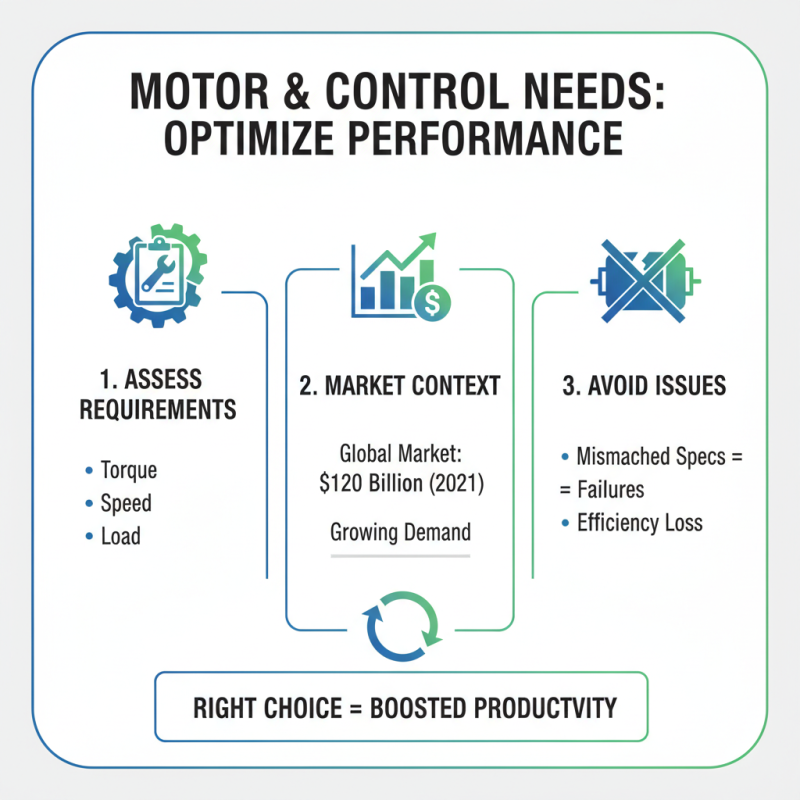
Identifying your specific motor and control needs is crucial for optimizing performance. Many industries rely heavily on motors; the global electric motor market was valued at approximately $120 billion in 2021 and is expected to grow. However, the choice of motor can greatly impact efficiency and productivity. Understanding torque, speed, and load specifications is vital. Many failures come from mismatched motor specifications.
Consider the type of application. For example, precision tasks may require servo motors, while general-purpose tasks might use induction motors. An IEEE report suggests that nearly 30% of industrial energy consumption comes from motors. Therefore, choosing the right motor not only enhances performance but also drives energy savings.
Reflecting on control systems, these too must match your specific needs. Whether using variable frequency drives or PID controllers, the choice can influence accuracy and energy deployment. A recent study indicated that optimized control strategies could improve efficiency by up to 20%. However, selecting a control system without understanding your motor's behavior might lead to less than ideal outcomes. Understanding the interplay between motor choices and control systems is key to achieving operational excellence.
Choosing the right motor and control system is essential for any project. Different types of motors serve various purposes.
For instance, AC motors are reliable for continuous operation, while DC motors excel in applications
requiring speed control. Stepper motors provide precise positioning, making them a favorite in robotics.
Evaluating these options helps ensure you find the best fit for your needs.
When assessing motor types, consider the power requirements
and operating environment. More powerful motors can handle heavier loads.
However, they may consume more energy, leading to higher costs. It's essential to match the motor size with the application needs.
Sometimes, more isn’t better.
Tips: Always think about the long-term implications of your motor choice. Prototyping can unveil unexpected challenges.
Test different motors under real conditions. Don't rush the decision. A well-informed choice leads to enhanced performance.
Reflect on past projects. Did the motor choice lead to complications? Learning from experience is key.
When selecting motor and control solutions, several factors come into play. One crucial consideration is application requirements. These requirements dictate the type of motor needed based on torque, speed, and power. For example, in industrial settings, a report from the International Energy Agency notes that motors can account for nearly 70% of electricity consumption. Thus, efficiency becomes vital.
Another significant factor is environmental conditions. Motors must withstand varying temperatures, humidity, and dust levels. In some cases, specialized coatings may be necessary to prevent corrosion. A study by the Electric Power Research Institute reveals that motors operating under optimal environmental conditions have a 15% higher operational life.
Moreover, integration with existing systems affects selection. Compatibility ensures seamless interaction between new motors and current control systems, avoiding costly adjustments. It's common for companies to overlook future scalability as well. A miscalculation in predicted growth can lead to inadequate solutions that may not meet future demands. These insights stress the importance of a comprehensive approach in selecting the right motor and control solutions.
Choosing high-quality motor and control solutions can vastly improve operational efficiency. According to a recent industry report, organizations that invest in superior motor technology see efficiency gains of up to 30%. This not only translates to cost savings but also enhances the reliability of machinery. High-quality solutions reduce the risk of breakdowns, leading to fewer production interruptions.
Moreover, advanced motors consume less energy, which contributes to sustainability efforts. A study by the International Energy Agency indicates that improving motor systems can reduce global energy consumption by 8%. This shift is critical as industries worldwide seek to lower their carbon footprints. It’s essential to invest wisely and choose options that balance performance and sustainability.
However, it’s important to become aware of the downsides. Initially, high-quality motors can be more expensive. Companies may struggle with the upfront costs. But consider the long-term savings. Inadequate solutions often lead to more frequent repairs, resulting in higher costs over time. Quality matters, and businesses should evaluate their options carefully. Proper investments can foster innovation and progress within industries while addressing economic and environmental challenges.