
How to Choose the Right Wire Rope Thread Lifting Loop?

Choosing the correct Wire Rope Thread Lifting Loop is essential for safe, efficient, and repeatable lifting work. This component may look simple, yet its diameter, thread design, working load limit, and material quality directly affect performance. A loop used on a compact machinery frame may require different specifications from one supporting steel beams on a busy construction site.

Real-world selection begins with the load, lifting angle, connection point, and operating environment. Measure the available thread carefully. Check whether the loop matches the equipment’s thread size and strength rating. Then inspect the rope construction, protective finish, and manufacturer’s test documentation. Small details matter. A poorly matched thread can create uneven loading, while corrosion may weaken an apparently sound loop.

Experience also shows that labels alone are not enough. Confirm the working load limit under the actual lifting angle, not only the vertical rating. Consider repeated lifting, vibration, temperature changes, and possible edge contact. Competent suppliers should provide traceable certificates and clear inspection guidance. Independent verification is worthwhile when the load is valuable or the lifting arrangement is complex.

Some choices remain less obvious. A larger loop is not automatically safer, and a stronger rope cannot correct an unsuitable connection. I have seen selection decisions focus too heavily on price, then overlook inspection access and replacement intervals. That approach deserves reconsideration. A reliable choice combines technical data, practical handling, and documented maintenance. Before purchasing, compare the loop’s specifications with the equipment manual and consult a qualified lifting professional when uncertainty remains.
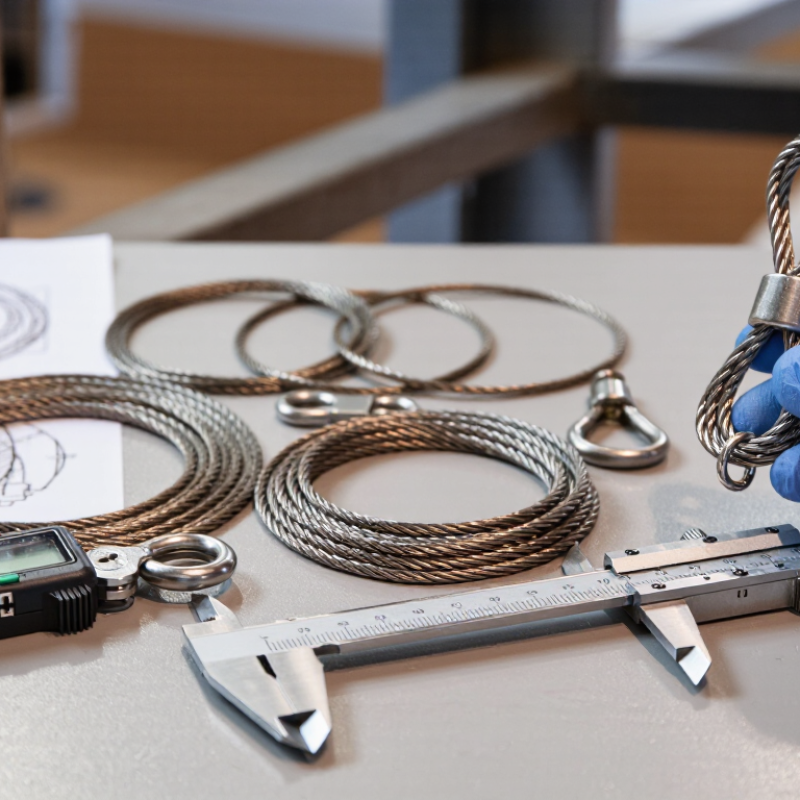
How to Choose the Right Wire Rope Thread Lifting Loop?

Understanding Wire Rope Thread Lifting Loop Design and Applications

How to Choose the Right Wire Rope Thread Lifting Loop?

A wire rope thread lifting loop is more than a cable bent into an eye. Its design includes rope diameter, core construction, eye length, ferrule type, thimble protection, and rated working load limit. A compact loop may fit a narrow lifting point, but poor curvature can crush the rope. Check the manufacturer’s load table, not appearance.

OSHA 1910.184 requires slings to show their rated capacity and receive regular inspections. That detail matters when loads swing, rotate, or lift at an angle.

Application changes the design. A thimble-supported eye suits repeated crane handling because it limits abrasion at the contact point. A soft eye may work for controlled, low-frequency lifting, but sharp hooks can flatten its crown. Keep the hook centered. Never force a loop onto a tip.

The angle between sling legs also increases tension; a 60-degree two-leg sling carries roughly 15% more tension than a vertical leg.

The U.S. Bureau of Labor Statistics recorded 1,069 fatal occupational injuries in transportation and material-moving occupations in 2023, showing why handling choices deserve careful review.

Inspect for broken wires, birdcaging, corrosion, heat marks, and slipped ferrules before each use. A clean loop can still be damaged inside.

I would also question “unused” stock stored near chemicals or moisture. Check it anyway.

Assessing Load Capacity, Dimensions, and Safety Factors

Choosing a wire rope thread lifting loop starts with its working load limit, not its appearance. The loop must support the planned load under real lifting conditions. Check the rated capacity certificate and compare it with the load weight, lifting angle, and connection method. A vertical lift may allow a higher capacity than a basket or choker arrangement. Angles change force quickly. Do not guess.

Dimensions also affect performance. Measure the rope diameter, eye length, throat opening, and contact area around the hook or shackle. The opening should accept the connector without forcing or twisting the loop. A tight bend can damage rope strands, even when the load stays below the rated limit. Check the minimum bend diameter recommended by the manufacturer and inspect the termination for slipping, crushed strands, corrosion, or broken wires. Small defects matter.

Safety factors require careful judgment. They are not a substitute for correct capacity selection. Use the applicable lifting standard, site procedure, and certified design data for the intended service. Dynamic loading, sharp edges, heat, and repeated cycles may reduce usable strength. Protective sleeves can help, but they cannot repair damaged rope. In practical inspections, people often focus on the label and overlook the connection angle. That is a weak habit. Recheck the setup before every lift, especially when dimensions or hardware change. Keep records of inspections, though records alone do not make unsafe equipment acceptable.

Selecting Materials, End Fittings, and Thread Configurations

How to Choose the Right Wire Rope Thread Lifting Loop?

Selecting the material begins with the working environment. Galvanized carbon-steel rope suits general construction and outdoor lifting. Stainless steel is better around moisture, chemicals, or hygiene-sensitive equipment. However, stainless steel can have different strength and fatigue behavior. Confirm the manufacturer’s rated capacity, rope diameter, grade, and safety factor before selection. OSHA 29 CFR 1910.184 requires lifting slings to carry permanent identification, including size, grade, and rated capacity. Missing tags are a serious warning.

End fittings must match the load path, not just the rope size. Threaded sockets, eyes, and ferrules need full engagement and correct installation torque. A short thread may look secure while concentrating force at the termination. That assumption is often wrong. ISO 4309 identifies discard concerns, including six randomly distributed broken wires in one rope lay, three broken wires in one strand, or a diameter reduction of 7% or more. Inspect the fitting transition carefully; crushed strands, opened wires, rust pockets, and uneven seating deserve rejection or expert review.

Thread configuration also affects handling. Fine threads can provide precise adjustment, but dirt may damage engagement. Coarse threads tolerate rougher sites, though they may offer less adjustment range. Match thread pitch, direction, engagement length, and locking method to the approved design. Record the inspection date and actual load history. The uncomfortable lesson is simple: a visually clean loop may still have hidden fatigue.

How to Choose the Right Wire Rope Thread Lifting Loop? - Selecting Materials, End Fittings, and Thread Configurations

Selection Dimension Available Option Typical Characteristics Recommended Use Important Verification
Wire Rope Material Bright carbon-steel wire rope High tensile strength and good fatigue performance when correctly selected and lubricated; limited corrosion resistance. Indoor lifting, dry workshops, general material handling. Confirm rope grade, construction, diameter, minimum breaking force, and inspection requirements.
Wire Rope Material Galvanized carbon-steel wire rope Zinc coating provides improved resistance to atmospheric corrosion compared with bright rope; coating can wear at contact points. Outdoor lifting, construction areas, marine-adjacent environments, and humid storage conditions. Check coating condition, corrosion loss, compatibility of sockets or fittings, and the applicable lifting standard.
Wire Rope Material Stainless-steel wire rope Good corrosion resistance in many environments; commonly selected in 304 or 316 stainless grades, with strength and fatigue behavior different from carbon steel. Food-processing areas, architectural applications, clean environments, and selected marine uses. Do not assume stainless rope has the same working load limit as carbon-steel rope of equal diameter; use manufacturer test data.
Rope Construction 6 × 19 or similar general-purpose construction Balanced strength, flexibility, and abrasion resistance; commonly used for general lifting and rigging. General-purpose lifting loops with moderate bending and handling demands. Verify the exact construction and lay because nominal construction names may include different wire arrangements.
Rope Construction 6 × 36 or similar flexible construction More flexible than many 6 × 19 constructions, but may offer lower abrasion resistance depending on the exact design. Applications involving repeated bending around sheaves or small working radii. Check the required diameter-to-bend ratio and the rope manufacturer’s fatigue guidance.
Rope Lay Regular lay Wires and strands are laid in opposite directions, giving better resistance to rotation, crushing, and kinking than lang lay in many applications. General lifting where load stability and handling control are priorities. Confirm whether the lifting system requires rotation-resistant or non-rotating rope.
End Fitting Threaded eye bolt or threaded lifting eye Provides a compact threaded attachment point; should be loaded in the intended direction and fully engaged in a compatible threaded hole. Equipment lifting points, fixtures, jigs, and removable lifting connections. Check thread diameter, pitch, engagement length, shoulder contact, material grade, and marked working load limit.
End Fitting Swaged threaded terminal A mechanically compressed terminal can provide a clean, compact termination when installed with approved equipment and procedures. Repeatable assemblies requiring a compact threaded connection. Confirm swage dimensions, inspection criteria, rope compatibility, and proof-test requirements.
End Fitting Open or closed spelter socket with threaded adapter Suitable for high-efficiency rope termination when correctly assembled; installation quality is critical. Heavy-duty lifting systems and applications requiring a robust permanent termination. Use the specified socketing compound and procedure; verify rope socket alignment and proof testing.
Thread Configuration Metric coarse thread Common metric configuration with comparatively robust thread depth and easier general-purpose assembly. Equipment designed to metric mechanical standards. Match nominal diameter and pitch exactly; do not mate metric and inch threads.
Thread Configuration Unified inch thread Uses inch-based nominal diameter and threads per inch; may be supplied as coarse or fine series. Equipment and lifting points designed to inch-thread standards. Confirm thread series, nominal size, pitch, fit class, and full thread engagement.
Thread Configuration Fine thread Provides more threads per unit length and can offer improved adjustment or vibration resistance, but is more sensitive to damage and contamination. Precision adjustment or applications where the mating component is specifically designed for fine threads. Use only when specified by the lifting-point design; verify torque and engagement requirements.
Load Direction Axial or in-line loading The fitting is aligned with the lifting force, generally providing the most favorable rated capacity. Vertical lifting with a properly aligned lifting point. Use the manufacturer’s rated capacity for the exact loading angle and configuration.
Load Direction Angled or side loading Capacity can decrease as the loading angle increases; side loading may bend or overstress a standard threaded eye. Only with a swivel or articulated lifting point specifically rated for angular loading. Obtain angle-specific capacity data; never assume the axial WLL applies to side loading.
Safety Factor Rated working load limit The WLL is determined from the complete assembly, including rope, termination, fitting, loading mode, and applicable regulations. Every lifting application. Select by certified assembly data rather than rope diameter alone; account for dynamic effects and load angles.
Inspection Requirement Pre-use and periodic inspection Inspect for broken wires, kinks, crushing, birdcaging, corrosion, heat damage, thread damage, deformation, and loose or damaged fittings. All wire-rope lifting loops and threaded lifting connections. Remove from service when rejection criteria in the applicable standard or manufacturer instructions are met.
Selection Note: The working load limit must be based on the complete tested assembly and the actual loading condition. Confirm the applicable standard, thread specification, rope construction, end-fitting installation method, proof-test requirements, and inspection criteria before use.

Matching the Lifting Loop to Equipment and Working Conditions

How to Choose the Right Wire Rope Thread Lifting Loop?

Matching the Lifting Loop to Equipment and Working Conditions

Choosing a wire rope threaded lifting loop starts with the equipment, not the load alone. Check the lifting point’s thread size, pitch, depth, and rated capacity. The loop must seat fully without forced tightening or visible gaps. Confirm the working load limit under the intended lifting angle. Angled loading can reduce capacity sharply. Never assume a larger loop is automatically safer.

Working conditions matter just as much. For outdoor lifting, inspect for corrosion, water entry, and damaged rope strands. Hot surfaces may weaken protective materials and reduce safe performance. Sharp edges can crush the rope, so use suitable edge protection. Keep the loop aligned with the load path. Side loading can twist the assembly and create uneven tension. A small mismatch may look harmless, but it can become serious during movement.

Tips: Clean the thread before fitting. Check the loop before every shift. Look for flattened strands, broken wires, bent fittings, and thread damage. Confirm the load’s center of gravity before lifting. Use a qualified person to verify the setup when conditions change. Photos and records can improve inspections, although they cannot replace hands-on checks. I have seen careful teams overlook angle changes after repositioning equipment. Recheck the setup whenever the lifting direction changes.

Inspecting, Installing, and Maintaining the Selected Lifting Loop

How to Choose the Right Wire Rope Thread Lifting Loop?

Choosing a wire rope thread lifting loop begins with the load, connection, and working environment. Check the required working load limit before selecting any loop. Consider load direction, lifting angle, temperature, abrasion, and available clearance. A loop suitable for vertical lifting may fail under side loading. Do not rely on appearance alone. Inspect the rope for broken wires, kinks, flattened sections, corrosion, and damaged threads. Small flaws matter.

During installation, clean the threaded connection and remove grit from the contact surfaces. Check that the rope, eye, thimble, and fitting are compatible. The loop should sit evenly in the hook or connecting point. Keep the load centered and prevent sharp edges from cutting into the rope. Tighten the connection according to verified technical instructions, not personal judgment. Never improvise. I have seen experienced workers overlook a slightly loose fitting during a rushed setup. That mistake deserves attention.

After every lifting operation, inspect the loop before storing it in a dry, ventilated area. Look for wire distortion, unusual stretching, heat marks, and damaged protective coatings. Rotate the inspection point so hidden areas are not ignored. Lubricate only with a compatible product and avoid covering existing damage. Remove any loop with serious deformation or uncertain history from service immediately. Record inspections, repairs, and usage conditions. A simple record often reveals repeated overload or poor alignment. Maintenance can feel repetitive, but it protects people and equipment.

Select Electrical Logo
Since 1988

Select Electrical Ltd. © Copyright 1988-2025