Top 10 Types of Industrial Electric Motors for Buyers
Industrial electric motors keep pumps moving, conveyors running, and compressors delivering steady pressure. Yet a motor that suits one production line may waste energy or struggle on another. Buyers need to look beyond horsepower and price. Load profile, starting torque, speed control, duty cycle, enclosure, and maintenance access all matter. A motor’s nameplate is useful, but it cannot tell the whole story.
This guide compares ten common types, including induction, synchronous, brushed DC, brushless DC, servo, stepper, and geared motors. It also considers specialized designs used where operating conditions demand extra protection or precise control. Motor-drive author Austin Hughes’s work offers a useful selection principle, paraphrased here: “Match the motor to its duty, not its catalogue label.” That means checking what happens during startup, peak load, and long hours at partial load. A conveyor carrying uneven cartons, for example, may need different torque and control than a fan running at a steady speed.
Small details matter. Check the supply voltage, mounting arrangement, ambient temperature, and available service space before comparing models. Even experienced buyers can overfocus on efficiency ratings and miss a poor fit for the actual load. That mistake is easy to make. The right choice balances performance, operating cost, reliability, and practical maintenance needs. These comparisons will help buyers ask sharper questions before requesting a quotation.
How Industrial Electric Motors Work and How They Are Classified
Industrial electric motors convert electrical energy into rotating shaft torque. In an AC motor, current in the stator creates a changing magnetic field; that field drives the rotor. In induction motors, the rotor follows the field with a small speed difference. Synchronous motors rotate in step with it. Heat still matters. Friction, poor alignment, and unsuitable loading can reduce useful output. The International Energy Agency’s Energy Efficiency 2024 report estimates that electric motor systems consume about 53% of global electricity, making correct selection and control significant.
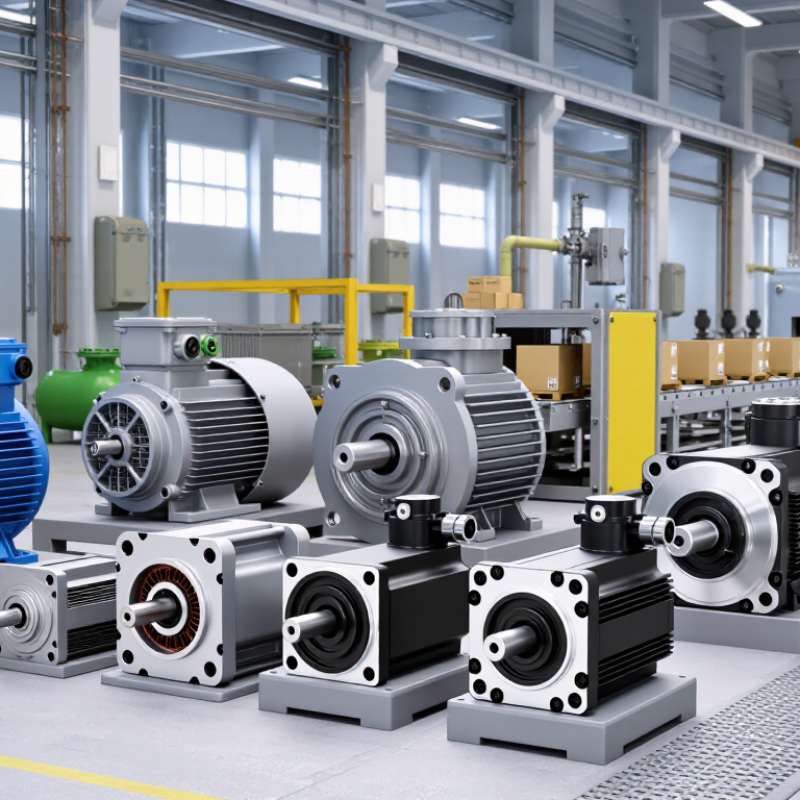
Buyers commonly classify motors by supply type, rotor design, and control method. AC induction motors are widely used for pumps, fans, and conveyors. Synchronous motors suit applications needing steady speed or high efficiency. DC motors include brushed and brushless designs; servo motors provide controlled positioning, while stepper motors move in defined increments. These categories overlap in real equipment. A servo, for example, describes a control system as much as a motor family.
Nameplate details help narrow the choice: voltage, frequency, rated speed, torque, duty cycle, and enclosure. A variable-frequency drive can adjust an AC motor’s speed, but it may also affect heat and insulation stress. Classification alone is not enough. Two motors with similar ratings can behave differently under repeated starts or heavy loads. This is where selection gets less tidy. Check the actual load profile, not only the catalog description.
AC Motor Types: Three-Phase, Single-Phase, and Synchronous Motors
Choosing an AC motor starts with the supply, load, and operating pattern. Three-phase motors suit many industrial machines because they provide smooth torque and work well with continuous loads. Pumps, compressors, and conveyor systems often use them. Check the starting current, enclosure, and duty rating against actual site conditions. A motor that looks adequate on a nameplate may struggle with frequent starts. That matters.
Single-phase motors are useful where three-phase power is unavailable or the load is modest. They commonly drive small pumps, fans, and workshop equipment. Starting components, such as capacitors, affect performance and maintenance needs. Do not choose by horsepower alone; consider how the machine starts and how long it runs.
Synchronous motors rotate in step with the supply frequency when operating within their design limits. They can suit applications requiring steady speed, and some installations use them to improve power factor. Their controls and starting arrangements may be more involved than those of standard induction motors. Not always. Compare lifecycle costs, including controls, service access, and downtime risk. A tidy specification sheet can miss an awkward detail: the motor must fit the real load, not just the planned one.
Top 10 Types of Industrial Electric Motors: Typical Efficiency Ranges
Efficiency varies with motor size, load, design, and operating conditions. The ranges shown are approximate reference values, not guaranteed ratings for every motor. Three-phase, single-phase, and synchronous motors are included alongside other common motor types.
DC and Precision Motor Types: Brushed, Brushless, Servo, and Stepper Motors
Brushed DC motors are simple to control and can deliver strong starting torque, making them useful for small conveyors and adjustable drives. Their brushes wear, though, so dust, heat, and maintenance access matter. Brushless DC motors replace mechanical commutation with electronic control. They generally need a compatible drive, but avoid brush replacement and suit continuous-duty equipment. Servo motors use feedback, often from an encoder, to correct position or speed in real time. Stepper motors move in discrete increments and can be economical for repeatable, moderate-speed positioning. Under heavy load, however, a stepper may lose steps without making the error obvious.
Motor choice also affects energy use at scale. The U.S. Department of Energy’s Industrial Electric Motor Systems Market Opportunities Assessment estimated that motor-driven systems used about 68% of electricity in U.S. manufacturing.
The report dates to 2002, so treat that figure as historical context, not a current benchmark. Still, it shows why selecting only by purchase price can be shortsighted. A small mismatch in torque, duty cycle, or control method can create heat, downtime, or excess energy use.
Tips: Match the motor to the load, not just the machine label. Check starting torque, speed range, accuracy, and expected operating hours. For a servo, confirm feedback and drive compatibility; for a stepper, test the real load at operating speed. Leave room for uncertainty: actual performance can differ from catalog ratings.
Specialized Motor Types: Gear, Torque, and Explosion-Proof Motors
Gear motors combine an electric motor with a reduction gearbox. They deliver lower speeds and higher output torque for conveyors, mixers, and packaging lines. Check the required shaft speed, load, and duty cycle before choosing one. A gearbox can add length and maintenance needs, so confirm it fits the available space and service plan.
Torque motors provide strong, controlled force at low speeds, including during brief holding or tensioning tasks. They can suit winding equipment and positioning systems. But prolonged stall operation may create excess heat. Check the motor’s thermal limits and cooling method against real operating conditions; calculations alone can miss messy starts and frequent stops.
Tips: For hazardous locations, select an explosion-proof motor rated for the specific environment and installation. Its enclosure is designed to contain an internal ignition and prevent it from igniting nearby gases or dust. Verify the required protection markings with a qualified engineer. Never treat a sealed-looking housing as proof of suitability. A small detail matters: dust buildup can affect cooling, even when the motor is correctly selected.
How Buyers Compare Motor Performance, Applications, and Operating Costs
Buyers should compare industrial electric motors by the work they must perform, not by rated power alone. An induction motor can suit a steady-duty pump, while a servo motor offers precise positioning for packaging equipment. For variable-speed fans or conveyors, check how efficiently the motor operates across its actual speed range. Nameplate efficiency matters, but so does the load profile.
Look beyond purchase price. A permanent-magnet motor may cost more upfront, yet lower energy use can matter during long operating hours. A brushed DC motor may be simple to control, but brush wear adds inspection and replacement tasks. Consider starting torque, duty cycle, enclosure, cooling, noise, and available supply voltage. Small details count. A motor exposed to dust or frequent washdowns needs suitable protection, not just a strong shaft rating.
Ask suppliers for performance data at the speeds and loads your process uses. Compare expected energy consumption, maintenance intervals, spare-part access, and installation requirements over the motor’s service life. A lower-cost option can become expensive if it needs frequent downtime. I would still treat lifecycle estimates cautiously: operating hours and energy prices often change, and buyers may overlook that uncertainty. Check the assumptions before committing.