What Are the Top Types of Light Beam Lamps in 2026?
In 2026, Light Beam Lamps range from compact LED fixtures to high-output moving heads built for large venues. The right type depends on where the beam must travel, how sharply it should cut through haze, and how much control an operator needs. “Light is the single most important element in the visual environment,” said architectural lighting designer Richard Kelly. His observation still applies: a bright beam is only useful when it supports the space and the people in it.
This guide compares key categories, including LED moving-head beam lamps, narrow-angle architectural fixtures, hybrid beam-and-spot units, and weather-resistant outdoor models. It looks beyond headline brightness. Beam angle, measured output, cooling, flicker behavior, control options, and enclosure rating all affect real-world performance. A narrow beam can draw a crisp line across a stage; a poorly matched fixture can create glare or uneven coverage. Small details matter.
The categories overlap—sometimes awkwardly. A hybrid fixture may serve several roles, but it may not excel at each one. The sections ahead explain where each lamp type fits, what trade-offs to expect, and which specifications deserve a closer look before purchase. Because product claims vary, compare reliable photometric data with a demonstration in the intended setting. That extra check can prevent an expensive mismatch.
How Light Beam Lamps Are Classified in 2026
What Are the Top Types of Light Beam Lamps in 2026?
Light-beam lamps are best classified by how they shape and control light, rather than by sales labels.
Spotlights form compact pools for shelves, artwork, or stage marks. Floodlights spread light across wider areas, such as workbenches. Wash lights aim for more even coverage, while profile lamps use shutters or optics to create sharp-edged shapes. A crisp edge does not guarantee even brightness.
Beam angle offers a measurable way to compare fixtures. IES photometric conventions define it by the points where light intensity falls to 50% of its peak; field angle uses the 10% points. These figures help distinguish a tight spot from a broad flood, but they do not describe beam quality on their own.
IES LM-79 testing reports photometric performance, including luminous intensity across angles, so buyers can compare measured distributions instead of relying only on labels. Check the actual photometric file, too. A “wide” beam can still leave dark patches on a wall.
LED Beam Lamps: Efficient and Versatile Lighting
LED beam lamps are popular because they direct light where it is needed while using less energy than many older lamp types. Their compact housings fit track heads, display fittings, and some stage fixtures. A narrow beam can pick out a ceramic vase or a sign across a dim room. A wider beam suits counters and work surfaces. Small details matter.
Check both lumens and beam angle before choosing a lamp. Wattage alone does not show how bright the lit area will feel. Color rendering also matters: a high CRI can help fabrics, food, and paint appear closer to their natural colors. For reading or detailed work, avoid a harsh pool of light; test the lamp from the actual viewing position. Glare is easy to underestimate.
LEDs usually produce less heat at the beam face than comparable older sources, but the fixture still needs suitable ventilation. Confirm dimmer compatibility, base type, and rated operating temperature. Some lamps flicker or shift color with incompatible controls. That is annoying, and easy to miss in a quick showroom test. For flexible use, adjustable-beam lamps can be useful, though their added mechanisms may cost more and need careful handling. A simple fixed-beam lamp is often the more reliable choice when the target never changes.
What Are the Top Types of Light Beam Lamps in 2026? - LED Beam Lamps: Efficient and Versatile Lighting
The figures below are indicative ranges for common fixture types, not specifications for every product. Actual beam angles, power, and light output vary by design.
| LED Beam Lamp Type | Typical Beam Angle | Typical Input Power | Common Applications | Key Characteristics |
| LED PAR spotlight | About 15°–60° | About 10–200 W | Stage washes, retail displays, accent lighting | A practical option for broad or moderately focused illumination; many versions offer dimming and color control. |
| LED moving-head beam fixture | Often about 2°–8° | About 100–400 W | Concerts, theaters, clubs, live events | Produces a tight, visible beam and can pan and tilt; output and beam appearance depend on optics, haze, and ambient conditions. |
| LED profile or ellipsoidal spotlight | Commonly about 5°–50°, depending on lens | About 50–300 W | Theater stages, galleries, presentation spaces | Creates a controlled, sharply defined beam; shutters or pattern holders can shape the illuminated area. |
| LED pinspot | Often about 3°–10° | About 3–30 W | Table centerpieces, small displays, decorative accents | A compact fixture for highlighting small objects or areas from a distance. |
| Narrow-beam LED architectural projector | About 5°–30° | About 10–150 W | Facade accents, monuments, landscape features | Designed to direct light onto a specific surface; outdoor models should be selected with an appropriate ingress-protection rating. |
| LED narrow-beam floodlight | About 10°–60° | About 20–300 W | Building exteriors, yards, signs, and outdoor work areas | Provides directional outdoor illumination; mounting height and aiming affect coverage and glare. |
Selection tip: Match the beam angle and fixture optics to the target area, mounting distance, required brightness, dimming needs, and indoor or outdoor conditions.
Moving-Head Beam Lamps: Directional Stage Effects
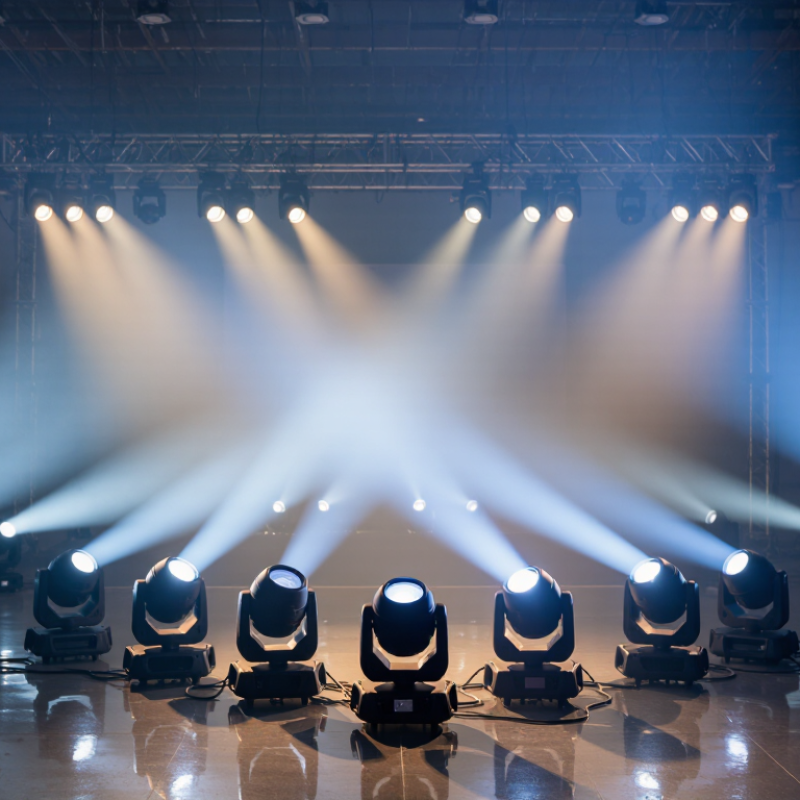
Moving-head beam lamps create sharp, concentrated shafts of light that can sweep across a stage, audience area, or backdrop. Their pan-and-tilt movement lets operators redirect beams quickly, while color changes and optional prisms add texture. A narrow beam can look vivid in a dark room, but it may appear less defined under bright ambient lighting. Keep that in mind.
For a small venue, check beam angle, output, movement range, and fixture weight before choosing a lamp. A very tight beam makes a striking aerial line, yet it can also feel harsh when aimed directly toward performers or guests. Careful cue programming helps: slow sweeps suit quieter passages, while sharper movements can support energetic transitions. Haze can reveal the beam in the air, where venue conditions and ventilation allow it. Test the effect from several audience positions, not only from the lighting desk. Even a well-designed cue can look uneven from the side. Reliable results also depend on secure mounting, routine lens cleaning, and allowing the fixture to cool as its manufacturer recommends.
Laser Beam Lamps: Narrow, Concentrated Light
Laser beam lamps create a tight shaft of light that can travel across a room with little spread. They suit stage effects, gallery accents, and architectural details where a precise line matters more than broad coverage. A narrow beam can pick out a balcony edge or cut through light haze above a performance. Crisp and controlled.
The label “laser beam lamp” does not always identify the light source. Some fixtures use laser diodes; others create a similar look with different optics. Check the product specifications, beam angle, output, and safety instructions before choosing one. A very narrow beam may look dramatic, but it illuminates only a small area. On a bright afternoon, its effect can seem surprisingly faint. That distinction is easy to miss.
Placement matters. Keep the beam away from viewers’ eyes and reflective surfaces, and follow the fixture’s operating guidance. In a venue, test the angle from several audience positions; a beam that looks clean from the control booth may glare from the front row. Allow room for ventilation, too. I would not assume that tighter always means better: a softer, wider fixture can be more useful for general lighting.
Searchlights and Followspots: Long-Range Beam Types
What Are the Top Types of Light Beam Lamps in 2026?
Searchlights and Followspots: Long-Range Beam Types
Searchlights and followspots both project narrow beams over distance, but they serve different purposes. A searchlight creates a visible shaft of light across a large space, such as an outdoor stage or venue façade. Its reach depends on the optical system, output, beam angle, and surrounding conditions. Haze can reveal the beam, while wind and rain may affect how clearly it appears.
A followspot is designed to keep a performer illuminated as they move. An operator can adjust its direction, focus, and intensity during a show. Some systems also support remote or automated tracking, but setup and programming matter. A brighter beam is not automatically better: too much output can wash out costumes or distract the audience. The right choice depends on throw distance, ambient light, and how precisely the beam must follow its subject. I’d still check sightlines in the actual venue; specifications alone can miss awkward shadows.
Tips: Measure the throw distance before choosing a fixture. Test the beam from the audience’s viewpoint, not only beside the lamp. Keep a safe clearance around the beam path, and confirm that controls are easy to reach during operation.
What Are the Top Types of Light Beam Lamps in 2026?
Searchlights and followspots are long-range beam types designed for different applications.
Representative operating ranges vary by fixture, optics, output, and conditions. Searchlights can project over much longer distances, while followspots are intended to keep performers clearly illuminated. The horizontal axis uses a logarithmic scale.